

Summary
- The report, “Pakistan’s Exposure to a Strait of Hormuz Shock: Fuel Pricing, Inflation, and External Vulnerability” by Ahsanul Haq Satti and Shahzada M Naeem Nawaz, explains how even a minor oil supply shock could quickly raise fuel costs, push inflation higher, and strain Pakistan’s external accounts.
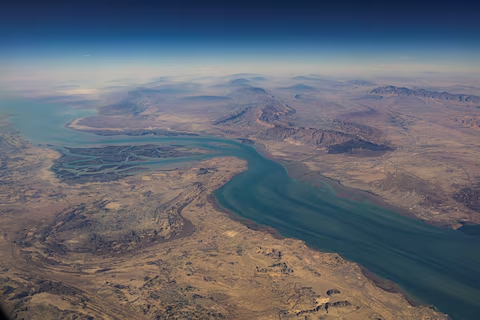
- Nearly 20 percent of global petroleum supply, about 20 million barrels per day, flows through the Strait of Hormuz.
- A stress scenario could drive inflation above 10.4 percent, while a severe shock could push inflation beyond 12 percent, with food and transport costs amplifying the crisis.
ISLAMABAD: A new study by the Pakistan Institute of Development Economics (PIDE) warns that Pakistan’s economy could face serious consequences if disruptions occur in the Strait of Hormuz, one of the world’s most vital energy routes.
The report, “Pakistan’s Exposure to a Strait of Hormuz Shock: Fuel Pricing, Inflation, and External Vulnerability” by Ahsanul Haq Satti and Shahzada M Naeem Nawaz, explains how even a minor oil supply shock could quickly raise fuel costs, push inflation higher, and strain Pakistan’s external accounts.
Nearly 20 percent of global petroleum supply, about 20 million barrels per day, flows through the Strait of Hormuz. Any interruption, whether caused by geopolitical tensions or logistical issues, can trigger immediate oil price spikes. For Pakistan, where energy imports account for more than 22 percent of total imports, the impact would be severe.
The study highlights that oil shocks affect more than crude prices. Freight costs, war-risk insurance premiums, exchange rate depreciation, taxes, and retail margins all magnify the burden on consumers. This creates multi-layered domestic price shocks that intensify inflationary pressures.
Researchers modeled three scenarios. A mild shock could push inflation to 8.8 percent within six months. A stress scenario could drive inflation above 10.4 percent, while a severe shock could push inflation beyond 12 percent, with food and transport costs amplifying the crisis.
The external balance also faces risks. Monthly petroleum imports could rise by up to $384 million, while the current account could swing from surplus to deficit. In severe cases, the annual external impact may exceed $4.6 billion.
High-speed diesel (HSD) plays a central role in transmitting inflation because of its importance in transport, logistics, agriculture, and food supply chains. Rising diesel costs ripple across the economy, driving second-round inflation effects.
To reduce vulnerability, the study urges policymakers to adopt transparent fuel pricing mechanisms, prioritize diesel monitoring, strengthen coordination among the State Bank, Ministry of Finance, and Petroleum Division, and provide targeted support for essential supply chains. Longer-term reforms should focus on reducing diesel dependence and building energy resilience.
PIDE concludes that Pakistan’s exposure to global energy shocks is deeper than commonly understood. A disruption in the Strait of Hormuz would not remain an external event but would quickly evolve into a domestic economic crisis.
We welcome your contributions! Submit your blogs, opinion pieces, press releases, news story pitches, and news features to opinion@minutemirror.com.pk and minutemirrormail@gmail.com