

Summary
- Habermas was known for shaping Germany’s political and social thinking after World War II.
- Habermas introduced the concept of the “public sphere.” He explained how citizens could discuss ideas, politics, and society openly.
- His ideas on free discussion, public debate, and political responsibility are studied by scholars around the world.
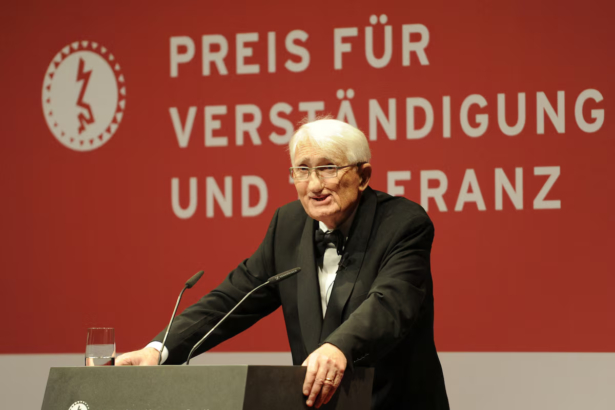
BERLIN – Juergen Habermas, a famous German philosopher and thinker, has died at the age of 96 in Starnberg, Germany, his publisher Suhrkamp confirmed. Habermas was known for shaping Germany’s political and social thinking after World War II. His ideas helped Germany deal with the past and guide its future.
Born in 1929 in Dusseldorf, Habermas grew up during the Nazi era. His father was a member of the Nazi Party but had limited involvement. Habermas himself joined the Hitler Youth, like most boys of his age. However, he avoided being drafted into the German army by hiding from military authorities near the end of World War II.
As a young man, Habermas studied philosophy and social sciences. He was influenced by a group of thinkers called the Frankfurt School, including Theodor Adorno and Max Horkheimer. These thinkers focused on understanding society, politics, and the dangers of authoritarianism. Habermas’s early work explored how people could speak freely in society and influence public decisions.
Habermas introduced the concept of the “public sphere.” He explained how citizens could discuss ideas, politics, and society openly. He traced this idea from the 18th-century salons of Europe to modern mass media. His work helped Germans, who had lived under Nazi dictatorship, understand the importance of discussion, debate, and democracy.
One of Habermas’s most important contributions was his work on Germany’s responsibility for the Holocaust. In 1986, he argued that Nazi crimes were unique and should never be forgotten. He believed that remembering and understanding the past was essential for building a fair and democratic society. His ideas helped Germany develop a strong culture of remembrance, teaching future generations the dangers of fascism and intolerance.
Habermas was also involved in European politics. He was cautious about Germany’s reunification in 1989, worried that nationalism might rise again. Later, he supported European integration, seeing it as a way to prevent conflict and maintain peace. Over time, he also discussed the role of religion in society, believing it could coexist with modern, secular life and help guide ethical behavior.
Even in his later years, Habermas remained active in public debates. In 2022, he spoke about the war in Ukraine. He supported cautious military aid to Kyiv but urged negotiations with Moscow. His views were criticized by some, showing that he never shied away from challenging opinions and speaking his mind.
Habermas’s personal life was intertwined with his work. He married Ute Wesselhoeft in 1955. They shared a love for literature, cinema, and modern art. Ute passed away last year. The couple had three children. Two of their children, Tilmann and Judith, survive him.
Habermas received international recognition for his work. He became a “public educator” for Germany, teaching people about democracy, justice, and the importance of remembering history. His influence extended beyond Germany. His ideas on free discussion, public debate, and political responsibility are studied by scholars around the world.
We welcome your contributions! Submit your blogs, opinion pieces, press releases, news story pitches, and news features to opinion@minutemirror.com.pk and minutemirrormail@gmail.com