

Summary
- Bulgaria’s political landscape appears to be shifting after exit polls showed a strong lead for the party of former President Rumen Radev in Sunday’s parliamentary election.
- It marks the eighth parliamentary vote in just five years, reflecting repeated government collapses and public frustration with political instability.
- Voter turnout appeared higher than in the previous election, reflecting increased public interest driven by Radev’s return to frontline politics and promises of political stability.
Bulgaria’s political landscape appears to be shifting after exit polls showed a strong lead for the party of former President Rumen Radev in Sunday’s parliamentary election.
Early results suggest Radev’s Progressive Bulgaria bloc is ahead by a wide margin. However, analysts say he will still need coalition partners to form a stable government.
Radev, a former fighter pilot known for his pro-Russian and eurosceptic stance, left the presidency earlier this year to enter parliamentary politics. His campaign focused heavily on fighting corruption and restoring political stability in the country.
The election comes after years of political uncertainty in Bulgaria. It marks the eighth parliamentary vote in just five years, reflecting repeated government collapses and public frustration with political instability.
Exit polls indicate Progressive Bulgaria secured a commanding lead, while the centre-right GERB party, led by former Prime Minister Boyko Borissov, trailed in second place. Smaller reformist groups also gained moderate support.
Radev told reporters after the exit polls that repeated elections are damaging for the country. He stressed the need for a stable government and expressed willingness to cooperate with other parties on key reforms, particularly in the justice system.
He also left open the possibility of leading a minority government if coalition talks fail to produce a broader agreement.
During his campaign, Radev called for improved relations with Russia and suggested restoring energy ties, including the flow of Russian oil and gas. His position may influence future foreign policy debates within Bulgaria, a member of both the European Union and NATO.
However, any potential coalition with pro-EU reform parties could moderate those positions.
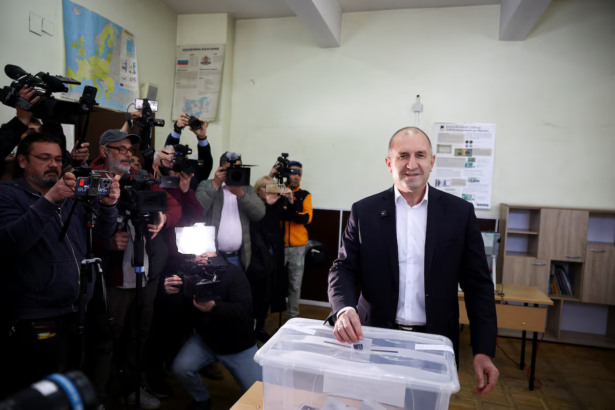
Voter turnout appeared higher than in the previous election, reflecting increased public interest driven by Radev’s return to frontline politics and promises of political stability.
Despite economic growth since joining the EU and adopting the euro, Bulgaria continues to face challenges including corruption, cost-of-living pressures, and political fragmentation.
Many voters expressed frustration with repeated elections and political deadlock, calling for leaders to prioritise governance and stability over internal disputes.
Final results are expected to be officially confirmed on Monday.
We welcome your contributions! Submit your blogs, opinion pieces, press releases, news story pitches, and news features to opinion@minutemirror.com.pk and minutemirrormail@gmail.com